A few years ago I heard about portfolio, but I didn’t really know what it means for testers. How do you put portfolio together for testers? Like, do you put your stories that you tested? Did you share your test plans your automation scripts? How is it actually looking like?
I’ve seen many portfolios for designers. It showcases style and techniques they use. It’s tangible work and visually understandable to many.
Over 18 months ago, I started collaborating very closely with Ministry of Testing community. My first engagement started with a long article I have written about quality assistance model I worked with at that time. I had a very good support and decided to stick around and contribute more. I participated in many events, I gave some talks, panel discussions, and hosted many, many This Week In Testing show on Fridays. Slowly my contributions started to stockpile and it became apparent it can be something bigger. At that time Ministry of Testing were leading the initiative of public profiles that reinforced my idea of portfolio.
So what is tester’s portfolio? It’s not a template nor checklist no matter how much we love both. It is essentially all your learnings, contributions, achievements, projects, hot takes, reflections, questions and conversations you put out there for people to read, listen, try and learn from you. It’s not only certifications and courses, it’s all those things.
Why do I bother about portfolio
Last February, I found myself in an awkward situation. I realised that a company that I was working at was not right fit for me and I had to be back on the market. It took me some time to accept it. Meanwhile, I kept collaborating with Ministry of Testing, became their ambassador for another year. Then I thought – Wouldn’t be amazing if new job comes to me and not me looking for it. Wouldn’t be amazing if my learnings, achievements, skills speak for me and not me selling them hard to a recruiter or a hiring manager. Instead, we can have a meaningful conversation what problems we need to solve and what outcomes we want to see of the roles they hire. I am not sure the market is ready for this type of hiring yet. What I know for sure is building my portfolio gave me a boost of confidence that I could leave my job without next offer. Throughout the process of building it, I understood what value I can bring to a company, I can articulate it or show it through the work I did. It gave me a very good job hunting kickstart. It felt powerful and liberating.
How do you build tester’s portfolio?
You need a little bit of strategy in place and maybe faith in yourself. Very often people say “Oh, I have nothing special to share. Everyone has shared, talked about things I’m doing myself. Who will even read me? That was also my thinking, it took me some time to understand it was not true.
A very good book from Austin Kleon helped me see the ways you can share your work differently and set your mindset into right direction. The idea is instead of thinking you need to share super duper projects or academic style blogposts, think about micro sharing as amateur, as someone who learns in public, not a professional who is asked to do things perfectly. You will eventually get there, but your first items in your portfolio might look rather simple. That’s expected. That’s the idea.
Where do I start?
My strategy is simple. I have drawn a little diagram what components I think my portfolio should have. Each component will have some underlying items, ideas to work on. This little roadmap is not final, some items can never make into reality, but having something to reiterate is important.
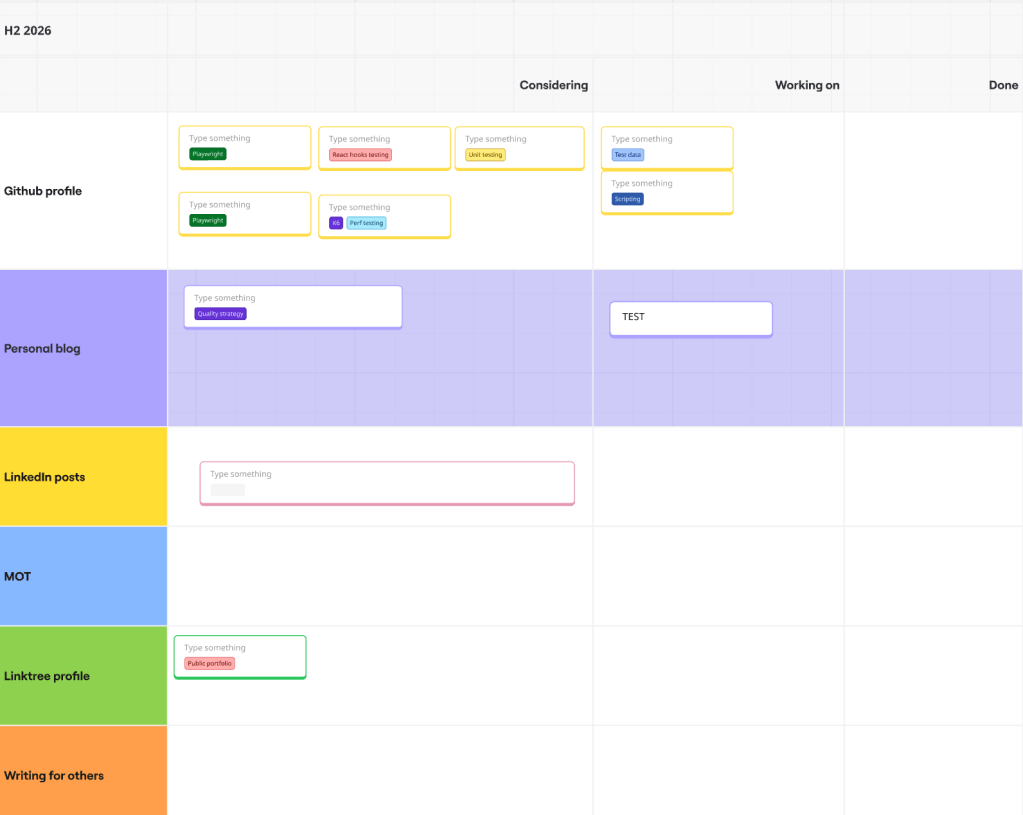
On monthly basis, I draft a few ideas what I want to contribute to my portfolio. Let’s say I want to write a blogpost or complete a course. I don’t always know what I want to write about. If things aren’t progressing, I might deliberately start searching for topic to write about. Even finding one and drafting a blogpost is also a good goal. My monthly goals will always have at least one item for portfolio.
On the other hand, I have a daily minimum learnings that eventually contribute into bigger projects. I read at least one article or watch one video or do some assignment for the topic I am interested in. It’s either, it’s not all three. As a result, I might try out learnings in practical way and share to people. I might write some short post on LinkedIn or jot down ideas for next blogpost. The idea of daily learnings is either it adds up to my monthly goal or produces tiny reflections and explorations I share with people. Win-win.
With the time, the question popped up where do I put all my learnings. I was very much hesitant to stick to social media, Medium or Substack. I often think having space on my own is special these days. I have full control, I don’t need to fight with gross social media algorithms. So I created one. I’m very much aware that the outreach might not be the same, but since it’s mine and I fully own it, I am fine with that. I have also created a linktree where everything lives together one click away and can be accessible by anyone.
Important thing about portfolio is to keep it diverse. It’s a mix of blogposts, talks, discussions, achievements and technical projects. It helps show variety of skills, areas I tried to discover. Building diverse portfolio is not a destination, it’s adapting and adjusting, so it stays relevant. So far it’s been two years with ups and downs.
Life is busy. I don’t have time for a portfolio
All things we do in life is about priorities. There are things that are urgent and we can’t postpone them. There are things other people depend on us doing. There are things that do not fall in any of those categories. Building portfolio is one of it and it might never be prioritised.
Elizabeth Gilbert once said on her masterclass that is similar along those lines – “If you really want to do something, you should give up on things you love doing“. We love seeing friends, going out, reading books, playing games. We can find many other things we love doing. On the other hand, when something comes up we really want to do, we struggle to find time. Often those things never materialise and the common excuse is there isn’t enough time. Right now I am writing this blogpost while giving up on reading my book. I temporarily gave up on many favourite books in order to do something I really wanted.
No, your life won’t turn into days you don’t do things you love. The idea is to give up at least one thing for a while to try out something you always wanted to do. Undeniably, it can be hard one to start. It happens to me as well.
“If you really want to do something, you should give up on things you love doing“
Elizabeth Gilbert
Closing thoughts
Everyone has very different objectives for their career. My objective is to build confidence and expertise, get clarity what value I bring as professional and eventually experience job search more like a walk on the beach and not a walk through seven circles of hell. I’m not sure it will work out the way I envision it, but it has parallel objectives that are pretty good as well. It also turned out I really enjoy doing it. So I bother.


Leave a Reply