Disclaimer: This article doesn’t suggest nor discuss to review job description for hiring process. It offers a different perspective on role description inside the organisation, how to make it interesting, impactful and more aligned with department and organisational objectives. Although, it would be wonderful to see similar approach in job description for hiring as well.
Role descriptions were often convoluted part in my career. Each time I joined the organisation, I hit the ground running, I did what was necessary, but often struggled to articulate my role. I would shortly say something along the line – I was a quality engineer, I tested software we built. I hoped everyone would understand what it would mean beyond those sentences. Some people smiled in response, some tried to clarify.
Needless to say, it was not my usual activity to think about my role, what it meant in simple language and how to explain it to others. Only a few years ago, when quality engineer role at the company I was became more squiggly, more difficult to mould into classic role description and after all classic task list format was not fit for purpose.
I was also lucky to work with wonderful Laurent Christoph who showed me how to think differently about the role. Thankfully to him I know role description can be interesting, meaningful and impactful. Now sharing to others what you do feels less awkward.
The flaw in classic role description
Role description document is often notoriously boring. Usually it is created with the purpose to hire people and once the process is over it becomes an historical token. No one comes back to it (it didn’t happen in my career), nor people keen to write a new one.
It often prescribes you a recipe of well-known techniques, buzzwords and tools in the industry, lists a long array of responsibilities that doesn’t have a lot of meaning behind them. Only a tiny percentage of job descriptions are designed to actually tell you what problems you should solve, how your role suppose to help organisation, how success looks like. No wonder, there are so many misplaced testing professionals, not enough joy at work and performance reviews are painful time at the end of the year for both employee and managers.
Job description that brings impact
Each role in the company has its own meaning and purpose. It’s only a question whether they are identified and described. Impactful role description doesn’t need to sound nor look sophisticated. It simply should map and reflect organisational or department objectives, challenges to solve, desired outcomes you expect to see.
To start with, role description could dive into these three parts:
- Key areas: your areas of work, collaboration and influence
- How winning looks like: to see your impact; ways to understand your success
- What will it take: things you would do to achieve the objectives; your daily practices
It’s not an exhaustive template for anyone’s role. You might want to consider other options and add to role definition. You might even have different role definition for the same role title. It often depends on the context, areas people work on and seniority.
Also the same role in the same organisation may not look the same after six-twelve months. Companies change, some of them are rapidly adapting to current market and economics. So roles change too. However, despite any changes, you can still create a meaningful role definition to help yourself or your direct reports thrive in the organisation.
Here in this blogpost I’d like to share how you look at role definition differently and what you can do should you want to experiment with it.
Key areas of the role
Your first step would be to identify key areas where your role is involved in and map it to company or department objectives. If there are company/departments objectives written and easily accessible to you, read them carefully and try to figure out where is your part in it. I know it’s not easy, but if you put your best effort to think about how to help, you can find a way to see your potential area of impact. If you don’t have one written, observe what the company or department tries to achieve, what challenge they want to tackle, how they communicate about them. You want to look for “The What”.
For example, as an organisation or engineering department they would like bring product value to users faster. On a more deeper level, it could mean to speed up or improve continuous delivery process, release daily without compromising quality. As you understand such change do not happen in isolation, a lot of teams will be involved to ensure smooth collaboration to achieve the goal. As a quality engineer you can play significant role to make sure it’s done with high quality in mind and in practice.
Key area example: Come up with testing strategies to help team move faster with high confidence.
How winning looks like
This is your area to see your impact and successes. You can also see it as whether you are on track or not. The title itself takes your into nearest future to showcase how things will positively change and influence others. You will think of it as measurement of success and understand if your actions shape outcomes and behaviours. In this section you are looking for successes and failures. It’s your area to identify underperforming ones and figure out how to bring them back to expected level. This is how role outcomes look like.
If we take the example from key area, the winning part should underline how successfully implemented testing strategies look in action, whether they boost confidence and how you can know you’ve done it well. If I’d like to write one down, I would look for the following outcomes.
How willing looks like example: A team is onboard with testing strategies for fast continuous delivery process. The team knows how to adopt, implement and maintain quality practices alongside of their development process. The team confidence matures, delivery speed improves and production issues aren’t increasing.
What will it take
You might have guesses from the title that this part is your actual doings. It’s a combination of any hands on, influence, mentoring and coaching part of the role you might need to bring onto the table to reach your outcomes.
Worth mentioning, not all objectives can be completely understood how to implement them. Some of them require discovery, proof of concept and experimentations particularly, when you are working in ambitious environment or exploring new technology, techniques. You need those discoveries as part of your doing plan to create space to explore, learn and figure out optimal solution. Ultimately, both exploration and immediate implementation build up “The How”.
The interesting moment with this section is that it can change, can be amended when needed. Not always we know all possible ways to achieve our goals, we should be open to adapt the plan when we feel it’s appropriate.
To illustrate what it will take to complete the goal we set earlier, I will try to throw a couple of ideas.
What will it take example: Access the current process and identify what slows team down. Access quality practices and suggest improvements. Increase testing coverage for core features on API level to get faster feedback. Help team adopt low level of testing and introduce unit testing for brand new functionality.
Anyone can redefine their job descriptions
Having meaningful role definition helps you know clearly what’s your value you bring into an organisation, where your impact is. You can also use it as navigation system for career growth, as a good material for performance review or in any other career conversations.
If you are an employee and interested in knowing what those valuable moments in your role are and how to recognise them, take initiative and see how you can approach your role definition differently. Have a think, play with template, shuffle things around. Show it to your manager and ask them what they think. No need to wait till your manager do it for you. It might never happen. Have that opportunity to bring something new and exciting to your role.
If you are a manager and interested in making your people’s role more clear, aligned and guiding them with consistency, please have a go as well. People would absolutely appreciate a fresh approach to their roles definitions, learn how it can go beyond task list.
Another benefit you can get is to help senior leadership understand better what quality engineers do and why they do what they do. It might be obvious to you, but it’s not so easy to grasp for others especially if they work across multiple value streams. Hep them connect the dots and create connections.
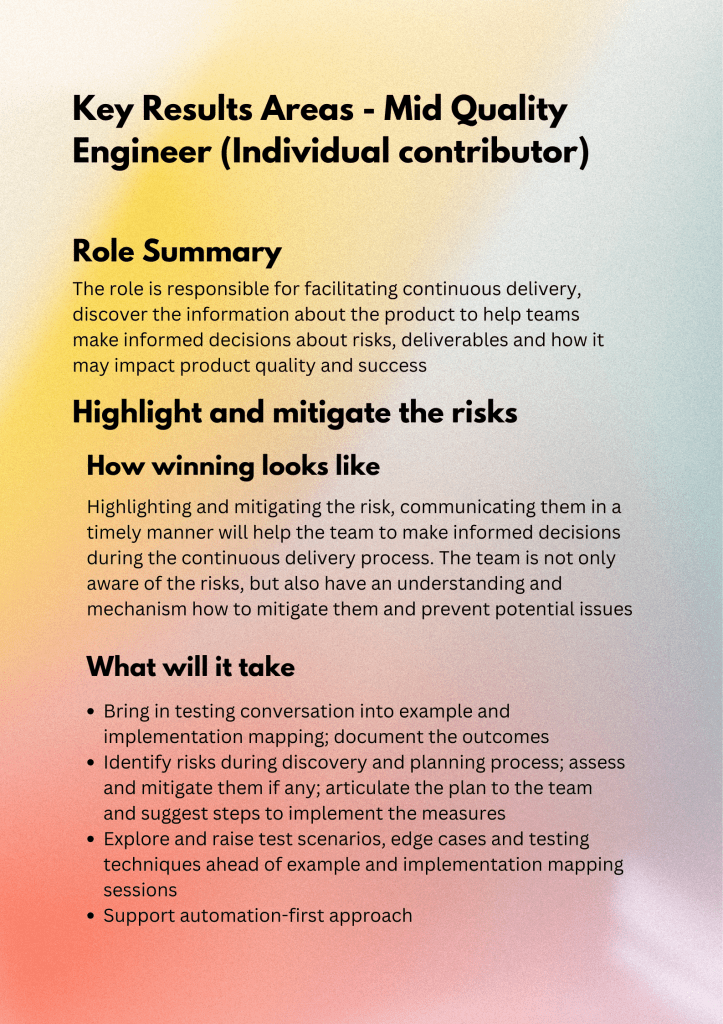
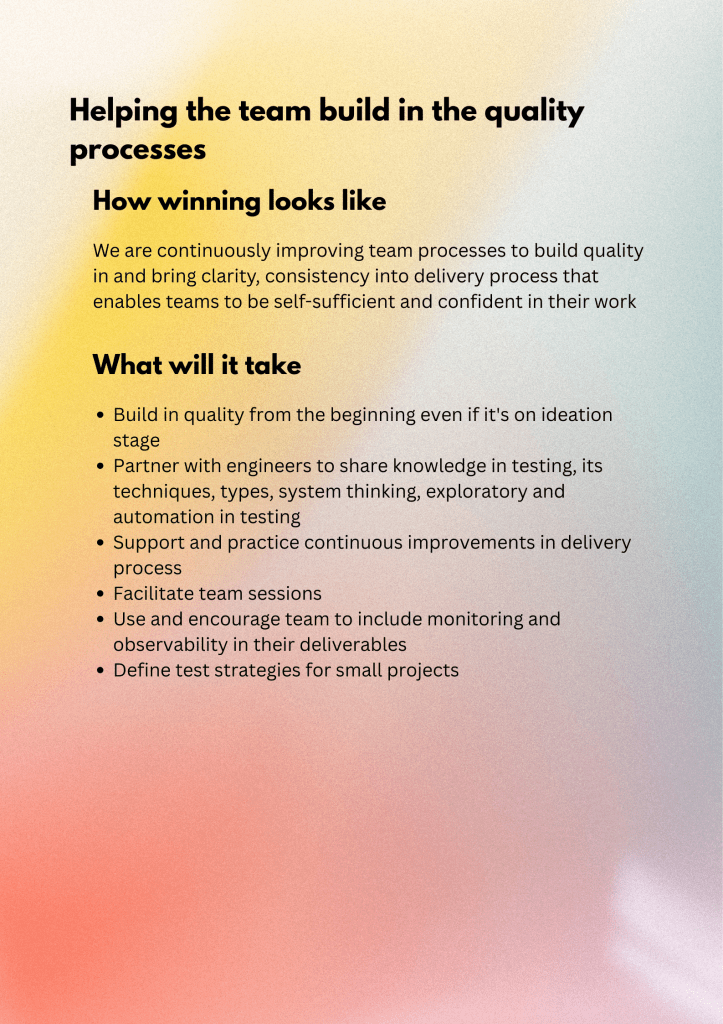
The template below illustrates how Mid Quality Engineer as individual contributor role might look like when all parts come together. Role summary can be written firstly if it’s something clear and known to you. Otherwise, it can be reverse engineered once you worked out all other parts. It might become more apparent to you once you explored key areas and drafted desired outcomes. Also the role definition is not limited to two key areas, it can have as many as you need depending on your situation and role you do.
 The Roundabout Cafe
Leave a comment